
The Therapist You're Paying $100,000 a Month For May Not Actually Be Licensed
- Apr 7
- 8 min read
Updated: Apr 13

When a family pays $50,000 to $100,000 or more for a residential stay at a luxury treatment facility, they are paying for what they reasonably believe will be the highest caliber of clinical care available. The marketing reinforces this expectation. Websites feature phrases like "world-class clinicians," "elite team of experts," and "highly skilled professionals." The implicit promise is clear: at these prices, you are getting the best therapists in the field.
What many families do not realize is that in a significant number of luxury rehab facilities across California, the therapist assigned to provide their loved one's primary individual therapy may not be licensed at all.
What ACSWs and AMFTs Actually Are
In California, the path to becoming a Licensed Clinical Social Worker (LCSW) or Licensed Marriage and Family Therapist (LMFT) requires completing a master's degree, registering with the Board of Behavioral Sciences (BBS) as an associate, and then accumulating 3,000 hours of supervised clinical experience over a minimum of 104 weeks. Only after completing those hours and passing both a law and ethics exam and a clinical exam does the clinician become fully licensed.
During the associate phase, the clinician holds the title of Associate Clinical Social Worker (ACSW) or Associate Marriage and Family Therapist (AMFT). They are, by the BBS's own classification, "not licensed practitioners." They are required to work under the supervision of a licensed clinician who assumes professional liability for the services they provide. Their clinical entries must be countersigned. They cannot practice independently, cannot open their own offices, and cannot bill insurance under their own credentials.
There is nothing inherently wrong with this system. It is how clinicians develop their skills. Associate therapists can be talented, compassionate, and effective. The problem is not that they exist. The problem is how luxury treatment facilities use them while charging rates that suggest something very different.
The Economics of the Associate Staffing Model
The financial incentive for luxury rehab facilities to staff with associates rather than fully licensed clinicians is significant. An AMFT or ACSW in the Los Angeles market earns between roughly $35 and $47 per hour. A fully licensed LMFT or LCSW with years of clinical experience in addiction treatment commands substantially more, both in salary and in the professional infrastructure required to recruit and retain them.
For a facility charging $75,000 or more per month for a residential stay, the margin between what the patient is paying and what the facility is spending on the clinician providing their primary therapy can be enormous. A patient paying $2,500 per day may be receiving individual therapy from a clinician earning $40 per hour who is still accumulating the supervised hours required for licensure.
This is not illegal. California law permits associates to provide therapy under supervision. But when a facility's marketing presents its clinical team as "elite" and "world-class" while staffing primary therapy roles with pre-licensed clinicians who are building their hours, there is a meaningful gap between the expectation being created and the service being delivered. At these price points, that gap raises serious questions about transparency and informed consent.
How Facilities Obscure the Distinction
The way luxury rehabs present their clinical staff often makes it difficult for families to identify who is licensed and who is not. Common practices include listing associate therapists on the facility's website alongside licensed clinicians without clearly distinguishing their credential status, using the title "therapist" or "clinician" without specifying whether the individual holds a license or an associate registration, highlighting the associate's graduate degree (MSW, MA) and areas of interest while omitting the fact that they have not yet completed licensure requirements, and featuring a small number of prominently credentialed clinicians (Ph.D., M.D., LCSW) on the "Our Team" page who serve in advisory or part-time roles while the day-to-day clinical work is performed by associates.
The result is that families reviewing a facility's website may reasonably conclude that the entire clinical team is composed of experienced, fully licensed professionals. In many cases, that conclusion would be wrong.
Why This Matters in Addiction Treatment
The distinction between a licensed clinician and an associate is not merely academic. In addiction treatment, therapists regularly work with patients who are medically fragile, psychologically vulnerable, and at elevated risk of relapse, self-harm, or medical crisis. The clinical judgment required to manage complex cases involving co-occurring disorders, trauma histories, medication interactions, and acute psychiatric symptoms is developed over years of supervised practice and independent experience.
An associate therapist who is six months into accumulating their 3,000 required hours may be a promising clinician. But they are not, by definition, the equivalent of a licensed therapist with five or ten years of independent practice. When a family is paying luxury rates, they are entitled to know the difference.
This is particularly significant in situations where clinical decisions have consequences beyond the therapy room. When a patient's condition deteriorates, when there are signs of medical distress, when environmental or safety concerns arise, the experience and independent judgment of a fully licensed clinician can be the difference between early intervention and delayed response. An associate, by the structure of their role, must defer clinical decisions to their supervisor. That chain of command introduces an additional step in situations where time may matter.
What Families Should Ask
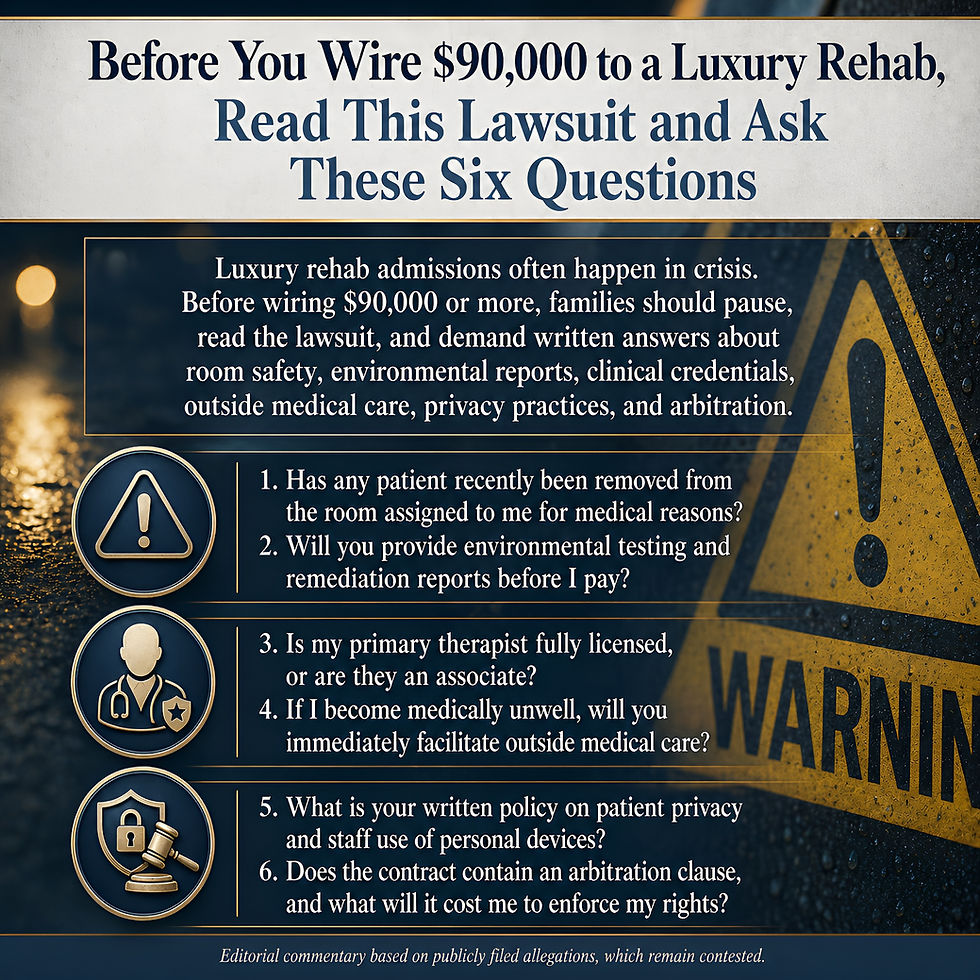
Before committing to a luxury treatment program, families should ask direct questions about clinical staffing. Specifically, they should ask whether their loved one's primary individual therapist will be a fully licensed clinician or an associate working toward licensure. They should ask what the ratio of licensed clinicians to associates is on the facility's clinical staff. They should ask whether the licensed clinicians listed on the facility's website are involved in day-to-day patient care or serve in advisory, consulting, or part-time capacities. And they should ask what specific supervision structure is in place for any associate clinicians providing direct patient care, including how frequently the supervising clinician reviews cases and how quickly the supervisor can be reached in a clinical emergency.
Any facility that is unwilling to answer these questions clearly, or that becomes defensive when asked, is telling you something important about how it views the relationship between its pricing and its clinical staffing.
The Regulatory Gap
California's Board of Behavioral Sciences regulates the licensure process and sets supervision requirements. But the BBS does not regulate how treatment facilities market their clinical teams to consumers. There is no requirement that a facility's website clearly distinguish between licensed and pre-licensed staff. There is no mandate that admissions materials disclose the credential status of the specific therapist who will be providing a patient's primary care. And there is no prohibition on marketing a clinical team as "elite" or "world-class" while staffing primary therapy roles with associates who are still completing their training.
This is a regulatory blind spot. At publicly funded community mental health agencies, the use of associate clinicians is well understood, expected, and priced accordingly. But at luxury facilities charging five to ten times those rates, the same staffing model is presented under a different set of marketing claims. The gap between the two is not a difference in legality. It is a difference in honesty.
The Broader Issue
The associate staffing question is part of a larger pattern in the luxury rehab industry: the gap between what is marketed and what is delivered. Just as facilities have been found to use curated Google reviews to present an artificial picture of patient satisfaction, the presentation of clinical staff credentials can create an equally misleading impression of clinical quality. In both cases, the family making the treatment decision is deprived of the information they need to evaluate whether the price they are paying corresponds to the care their loved one will actually receive.
Luxury pricing should come with luxury transparency. Families paying premium rates deserve to know exactly who will be providing their loved one's care, what that clinician's credential status is, and how the facility's clinical staffing compares to what its marketing suggests. Until regulators require that level of disclosure, the burden falls on families to ask the questions that the industry would prefer they did not.
Sources
California Board of Behavioral Sciences, "Licensed Marriage and Family Therapist" licensure requirements. https://www.bbs.ca.gov/applicants/lmft.html
California Board of Behavioral Sciences, "Licensed Clinical Social Worker" licensure requirements. https://www.bbs.ca.gov/applicants/lcsw.html
California Board of Behavioral Sciences, "Supervisor Resources." https://www.bbs.ca.gov/licensees/supervisor.html
California Board of Behavioral Sciences, "Summary of Supervisor Qualifications," revised September 2024. https://www.bbs.ca.gov/pdf/supervisor_qualifications.pdf
California Board of Behavioral Sciences, "Marriage and Family Therapist FAQ." https://www.bbs.ca.gov/pdf/publications/mft_faq.pdf
California Department of Health Care Services, "Reimbursement for Associate Clinical Social Worker and Associate Marriage and Family Therapist Services," 2020 (confirming ACSWs and AMFTs are "not licensed practitioners" under BBS classification). https://files.medi-cal.ca.gov/pubsdoco/newsroom/newsroom_30339_66.aspx
TLA Therapy, "Clinical Supervision Rules for LCSWs, AMFTs, and ASWs in California," 2025. https://www.tlatherapy.com/blog/lcsw-supervision-rules-california
License Journey, "ASW to LCSW California: Step-by-Step Guide," 2026. https://licensejourney.com/guides/asw-to-lcsw-california
Hansei Solutions, "Can a Non-Licensed Therapist Bill Insurance?" 2025. https://hanseisolutions.com/can-a-non-licensed-therapist-bill-insurance/
California State Auditor, Report No. 2023-120, "Drug and Alcohol Treatment Facilities," October 2024. https://www.auditor.ca.gov/reports/2023-120/
DISCLOSURE AND LEGAL NOTICE
Behind The Pointe is published by Verdict Public Relations, LLC, a public relations company owned and operated by the plaintiff in Hickman v. James & Bentz, Inc., et al., Case No. 25SMCV04669 (Los Angeles Superior Court). All content on this site is published at the direction of, and reflects the editorial perspective of, the plaintiff in that action. This site represents one party's perspective on pending civil litigation. This is disclosed so that readers may evaluate the content with full knowledge of its source and make their own independent judgments.
Certain articles on this site reference or discuss press releases distributed by Verdict Public Relations, LLC through third-party newswire services, including Access Newswire. Where such press releases have appeared on media platforms (including but not limited to the Associated Press, USA Today, Yahoo Finance, and Digital Journal), those appearances reflect paid press release distribution through a newswire service, not independent editorial coverage or endorsement by those outlets. This distinction is disclosed for transparency.
Where this blog references court filings, pleadings, or other official records, such content constitutes a fair and true report of public judicial proceedings within the meaning of California Civil Code Section 47(d). All factual statements regarding the litigation are based on and limited to information contained in publicly filed court documents. Any factual claim that is attributed to a complaint, motion, opposition, or other court filing reflects the contents of that filing as publicly recorded and does not represent an adjudicated finding, judicial determination, or independently verified fact unless expressly stated otherwise.
All other content on this site, including analysis, commentary, characterization, and editorial framing, constitutes protected opinion on matters of public concern, including patient safety, regulatory oversight, and accountability in the addiction treatment industry. Such statements reflect the subjective views and interpretation of the publisher, are not assertions of independently established fact, and are intended to be understood as opinion and commentary within the meaning of the First Amendment and Article I, Sections 2 and 3 of the California Constitution. Readers are encouraged to review the underlying public records and form their own conclusions.
No statement on this site should be interpreted as a finding of wrongdoing, an adjudication of liability, or a determination of fault by any court or governmental body. All individuals and entities referenced herein are presumed innocent of any allegations unless and until a court of competent jurisdiction determines otherwise. The litigation referenced on this site is pending and unresolved. The claims asserted in the referenced court filings are allegations only.
Where this site references government reports, audits, regulatory data, or publicly available licensing records, such content constitutes reporting on matters of public concern and does not relate to any specific pending litigation unless expressly stated.
The publisher reserves all rights and defenses under the First Amendment, the California Constitution, and California's Anti-SLAPP statute (Cal. Code Civ. Proc. Section 425.16), including the right to seek recovery of attorney's fees and costs in response to any action targeting the content of this blog. Any legal action arising from or relating to the content of this site shall be subject to these protections.
Nothing on this site constitutes legal, medical, or professional advice. Court filings referenced on this site are available through the Los Angeles Superior Court civil case access portal using Case No. 25SMCV04669. Readers are encouraged to review all underlying records independently before forming any conclusions.
For corrections or inquiries: pr@verdictpublicrelations.com


Comments