
What Families Should Know Before Choosing a Residential Treatment Facility
- Mar 30
- 7 min read
Updated: Apr 13

Choosing a residential treatment facility for a family member is one of the most consequential decisions a family can make. It is also one of the most difficult to make well.
The decision typically happens under pressure. A loved one is in crisis. Time feels short. Emotions are running high. In that environment, families often rely on the information most readily available to them: a facility's website, a physician's referral, online reviews, and the assurances of an admissions team whose job is to convert inquiries into admissions.
That is not a criticism of families. It is a description of the structural conditions under which these decisions are made. And it is precisely why families need better tools, better questions, and better access to independent information before committing tens of thousands of dollars and, more importantly, a vulnerable person's safety to a residential program.
The Information Gap
Residential treatment facilities control most of the information that families use to evaluate them. The facility's website describes its philosophy, amenities, and clinical approach. The admissions team answers questions and manages expectations. Marketing materials emphasize success stories, luxury accommodations, and clinical credentials.
What families typically do not see is the facility's inspection history, its complaint record with the California Department of Health Care Services (DHCS), whether it has faced enforcement actions, whether prior patients have filed lawsuits, whether environmental or safety concerns have been documented, or whether the facility's marketing claims are supported by its actual regulatory standing.
This gap is not unique to any single facility. It is a structural feature of the industry. And it is widened by the fact that many families are making this decision for the first time, under emotional duress, with limited knowledge of what questions to ask or where to find independent information.
What "Luxury" Does and Does Not Mean
The word "luxury" appears frequently in residential treatment marketing. Families should understand what it does and does not signify.
"Luxury" is a marketing term, not a regulatory classification. DHCS does not distinguish between luxury and non-luxury facilities in its licensing, inspection, or complaint processes. A facility charging $50,000 or more per month is subject to the same biennial inspection cycle, the same complaint investigation timelines, and the same staffing requirements as a facility charging a fraction of that amount.
Premium pricing may reflect higher-quality amenities, lower patient-to-staff ratios, or more individualized programming. It may also simply reflect real estate costs, marketing budgets, and the price that the market will bear for a facility in a desirable location. The price alone does not tell a family whether the facility is well-run, whether its clinical staff are appropriately credentialed, whether its physical environment is safe, or whether it has a history of complaints or enforcement actions.
Families should evaluate a facility's regulatory record and clinical substance independently of its pricing and marketing presentation.
Questions to Ask Before Admission
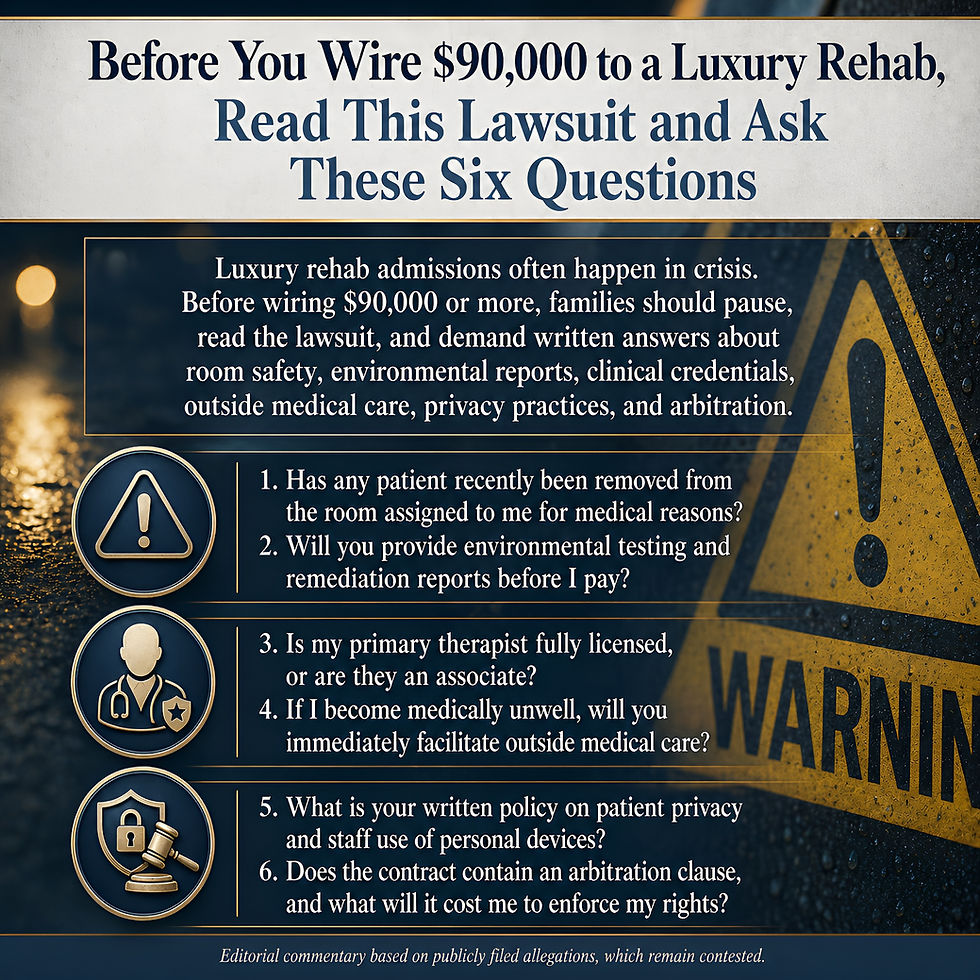
Before committing to a residential treatment program, families should consider asking the following questions directly and expecting clear, documented answers.
Licensing and Inspection. Is the facility currently licensed by DHCS? When was the last compliance inspection? Were any deficiencies identified? Were they corrected? Has the facility ever had its license suspended or been placed on probation? Families can independently verify a facility's license status through the DHCS Substance Use Disorder Compliance Division directory.
Complaints. Has the facility been the subject of complaints filed with DHCS? What were the outcomes? Families can file complaints directly with DHCS and should understand that the complaint investigation process exists as a mechanism for accountability.
Staff Credentials. What clinical credentials do the staff hold? Are counselors licensed or certified as required by California law? Who will serve as the patient's primary therapist, and what is that person's licensure level? State regulations require that at least 30 percent of a facility's alcohol and drug counselors be licensed or certified. Families should ask whether the staff members providing direct clinical care hold independent licenses or are working under supervision.
Environmental Safety. Has the facility conducted recent environmental assessments, including for mold, water intrusion, air quality, or other habitability concerns? What is the facility's protocol for disclosing environmental or safety issues to patients and their families? Are smoke detectors, fire safety systems, and emergency protocols current and functional?
Medical Oversight. What is the facility's protocol if a patient's condition worsens during the stay? Who makes the decision to escalate care or refer to a hospital? What is the process for sharing medical information with outside physicians? How quickly are records produced when requested by a patient's treating physician?
Referral Relationships. How did the patient come to be referred to this facility? Does the referring physician have a financial or professional relationship with the facility? Families should understand whether a referral reflects an independent clinical judgment or an established business relationship.
Contractual Terms. What does the financial agreement actually promise? What accommodations are included? What is the refund policy if the patient leaves early, is discharged, or requires hospitalization? Are there arbitration clauses or jury trial waivers in the agreement? Families should read the full financial agreement carefully before signing, and should not hesitate to ask for time to review it with an attorney.
Disclosure Practices. What is the facility's policy on disclosing material information about the living environment, prior incidents, or known risks? Has the facility ever been the subject of litigation? A facility's willingness to answer these questions directly and transparently is itself informative.
Why Independent Verification Matters
Families should not rely solely on a facility's own representations. Independent verification through publicly available records is both possible and important.
DHCS maintains a publicly accessible directory of licensed and certified treatment facilities. Families can verify license status, facility location, and bed capacity. Complaints about licensed facilities can be filed directly with DHCS through its online complaint form.
The California State Auditor's October 2024 report (Report 2023-120) found that DHCS conducted half of its required compliance inspections late and took more than a year to complete over a third of complaint investigations. These findings underscore the importance of families doing their own due diligence rather than assuming that state oversight alone is sufficient to ensure quality and safety.
Court records are publicly accessible through the Los Angeles Superior Court civil case access portal and through county court systems statewide. Families can search for lawsuits involving a facility or its operators to understand whether there is a pattern of litigation.
Online reviews can provide useful context but should be evaluated carefully. Some facilities have faced allegations of manipulating online reviews or operating review platforms with undisclosed conflicts of interest. Independent, third-party sources of information are more reliable than reviews hosted on a facility's own website or on platforms with opaque editorial standards.
The Decision Deserves Time
The treatment industry often emphasizes urgency. Admissions teams are trained to move families from inquiry to commitment quickly. In some cases, urgency is genuinely warranted. In others, the urgency serves the facility's census goals more than the patient's clinical needs.
Families should give themselves permission to slow down. A day spent asking hard questions, reviewing public records, and consulting with an independent physician or attorney is a day well spent. A facility that cannot tolerate a 24-hour pause for due diligence may not be a facility that prioritizes the patient's interests over its own.
Resources
DHCS Licensed Facility Directory: data.chhs.ca.gov
DHCS Complaint Filing: dhcs.ca.gov/individuals/Pages/Sud-Complaints.aspx
California State Auditor Report 2023-120: auditor.ca.gov/reports/2023-120
SAMHSA Treatment Locator: findtreatment.gov
Los Angeles Superior Court Civil Case Access: lacourt.ca.gov
This article is a consumer information resource and does not reference or relate to any specific pending litigation. It is based on publicly available regulatory information, the California State Auditor's Report 2023-120, and generally applicable consumer protection principles.
DISCLOSURE AND LEGAL NOTICE
Behind The Pointe is published by Verdict Public Relations, LLC, a public relations company owned and operated by the plaintiff in Hickman v. James & Bentz, Inc., et al., Case No. 25SMCV04669 (Los Angeles Superior Court). All content on this site is published at the direction of, and reflects the editorial perspective of, the plaintiff in that action. This site represents one party's perspective on pending civil litigation. This is disclosed so that readers may evaluate the content with full knowledge of its source and make their own independent judgments.
Certain articles on this site reference or discuss press releases distributed by Verdict Public Relations, LLC through third-party newswire services, including Access Newswire. Where such press releases have appeared on media platforms (including but not limited to the Associated Press, USA Today, Yahoo Finance, and Digital Journal), those appearances reflect paid press release distribution through a newswire service, not independent editorial coverage or endorsement by those outlets. This distinction is disclosed for transparency.
Where this blog references court filings, pleadings, or other official records, such content constitutes a fair and true report of public judicial proceedings within the meaning of California Civil Code Section 47(d). All factual statements regarding the litigation are based on and limited to information contained in publicly filed court documents. Any factual claim that is attributed to a complaint, motion, opposition, or other court filing reflects the contents of that filing as publicly recorded and does not represent an adjudicated finding, judicial determination, or independently verified fact unless expressly stated otherwise.
All other content on this site, including analysis, commentary, characterization, and editorial framing, constitutes protected opinion on matters of public concern, including patient safety, regulatory oversight, and accountability in the addiction treatment industry. Such statements reflect the subjective views and interpretation of the publisher, are not assertions of independently established fact, and are intended to be understood as opinion and commentary within the meaning of the First Amendment and Article I, Sections 2 and 3 of the California Constitution. Readers are encouraged to review the underlying public records and form their own conclusions.
No statement on this site should be interpreted as a finding of wrongdoing, an adjudication of liability, or a determination of fault by any court or governmental body. All individuals and entities referenced herein are presumed innocent of any allegations unless and until a court of competent jurisdiction determines otherwise. The litigation referenced on this site is pending and unresolved. The claims asserted in the referenced court filings are allegations only.
Where this site references government reports, audits, regulatory data, or publicly available licensing records, such content constitutes reporting on matters of public concern and does not relate to any specific pending litigation unless expressly stated.
The publisher reserves all rights and defenses under the First Amendment, the California Constitution, and California's Anti-SLAPP statute (Cal. Code Civ. Proc. Section 425.16), including the right to seek recovery of attorney's fees and costs in response to any action targeting the content of this blog. Any legal action arising from or relating to the content of this site shall be subject to these protections.
Nothing on this site constitutes legal, medical, or professional advice. Court filings referenced on this site are available through the Los Angeles Superior Court civil case access portal using Case No. 25SMCV04669. Readers are encouraged to review all underlying records independently before forming any conclusions.
For corrections or inquiries: pr@verdictpublicrelations.com


Comments